Apr 03, 2026

Every marketer has heard it: "AI is changing everything." But what does that actually mean for your campaigns, your team, and your budget right now? The impact of AI on digital marketing is no longer a prediction — it's a measurable reality reshaping how brands attract, engage, and convert customers across every channel.
In short: AI in digital marketing automates execution, supercharges personalization, cuts content production time by up to 70%, and enables real-time decision-making at a scale no human team can match alone. But here's the catch: the brands winning with AI aren't the ones using the most tools. They're the ones combining AI efficiency with sharp human strategy. In 2026, that balance will define who grows and who gets left behind.
This article breaks down the five biggest AI-driven shifts in digital marketing, what they mean for your strategy, and exactly how to prepare before your competitors do.
AI will impact digital marketing by making campaigns more predictive, personalized, automated, and adaptive in real time. Instead of relying only on past data and manual decisions, marketers will use AI to understand user intent faster and adjust content, targeting, search visibility, and customer journeys as they happen.
The biggest changes will be seen in 5 areas:
Area | Marketing in 2024 | Marketing in 2026 (AI-driven) |
Content production | Manual briefs, slow drafts, high agency costs. One piece takes days. | AI drafts first versions in minutes. Teams focus on editing, brand voice, and strategy. |
Targeting | Demographics and broad segments (age, gender, location). Spray-and-pray approach. | Behavioral signals, purchase intent, and predictive scoring. Audiences built in real time. |
Personalization | Segment-level: all users in a group see the same message. Limited dynamic fields | Individual-level experiences across channels. AI adapts content, offers, and timing per user. |
Decision-making | Weekly or monthly PDF reports reviewed in team meetings — decisions lag behind real market signals by days or weeks. | Live dashboards with AI-generated narrative summaries — no need to interpret raw charts manually. Predictive forecasting built into campaign tools — AI projects outcomes before spend is committed. |
SEO | Keyword-volume-based optimization. Desktop-first. Text-only content dominates. | Semantic, intent-driven, voice, and visual search. AI Overviews shift click behavior significantly. |
Data sources | Third-party cookies drive retargeting, lookalike audiences, and cross-site tracking — all under growing legal pressure. | First-party data (collected directly from users with explicit consent) becomes the primary fuel for all AI models. |
Traditional campaign-based thinking is slowly being replaced by continuous optimization and real-time adjustments. This reflects the ongoing transformation caused by the influence of AI on digital marketing.
Here is what AI can help achieve:
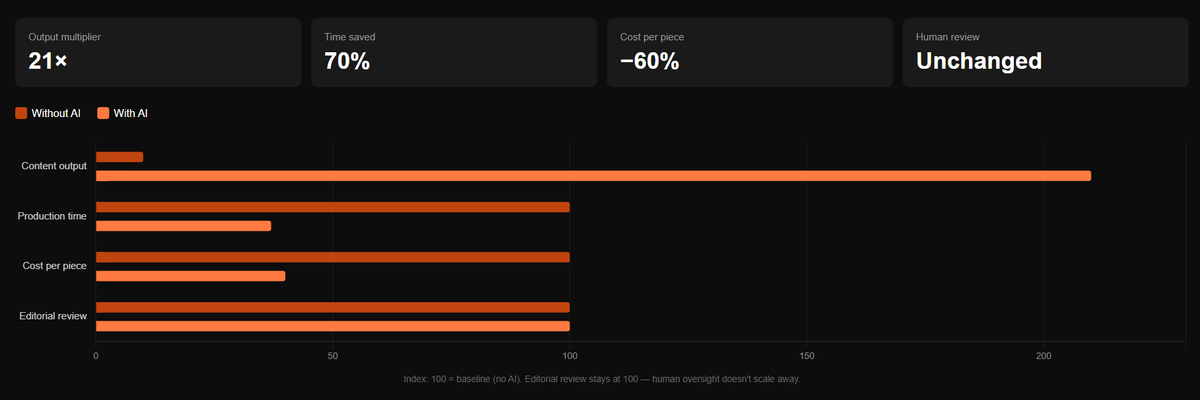
One of the most obvious ways that AI will change things is in the area of content creation. AI tools cut content production time by up to 70%, enabling teams to produce 21x more output. By 2026, it will be normal to use AI to write first drafts, come up with ideas, and even make multimedia content. This is where the generative AI impact on digital marketing 2026 becomes especially visible.
But this doesn't mean that human input is less important. The opposite is actually true. As AI makes more content, the quality and uniqueness of that content become the most important things that set it apart in the future of marketing.
What is changing in the way we make content:
Personalization gets better. Data is even more important. At the same time, people are expecting more privacy. That's why rules keep changing. This makes a balance that marketers need to be careful with. Data is what AI needs. But users want to know how their data is being used and have control over it.
Here are the most important changes that marketers can use to their advantage:
The change is already happening, and being an early adopter can give you a big edge over your competitors. The AI impact on digital marketing is accelerating, and marketers who embrace early adoption will benefit the most with their digital marketing promotion approach. Marketers who change their strategies early will be better able to use AI in a planned way instead of a reactive way.
Here are the most important things to do:
AI will not take the place of digital marketing. The latter is being transformed by artificial intelligence to become more personalized, data-driven, and dynamic. This ongoing transformation clearly shows the influence of AI on digital marketing. By 2026, the tools will not have changed as much as how marketers work in the future. There will be a rise in both the speed and automation in execution. Meanwhile, expertise, planning, and innovativeness will be core.
Finding the correct balance is where the real opportunity is. AI is capable of handling efficiency and scale. But human insight creates meaningful relationships. And that human component will be more important than ever in a world where everything is automated and driven by AI adoption.
AI is completely redefining how marketing works from the ground up. Businesses that adapt automation, personalization, and data intelligence tools early will be better positioned to compete and grow. The key trend is to combine technology with strategy.
At Redhead DA, we don't just follow digital marketing trends. We build strategies around them, helping brands grow faster and convert better. A marketing audit is a good place to start if you want to see where AI and strategy can convert into killing SEO results. Let this powerful symbiosis move the needle for your business.
Q: Is AI replacing digital marketers?
A: No. AI automates repetitive tasks like data analysis, ad targeting, and content drafting, but strategy, brand voice, and creative direction still require human expertise. The role shifts from executor to director.
Q: What is the biggest impact of AI on digital marketing in 2026?
A: Hyper-personalization at scale. AI can now tailor content, timing, and messaging to individual users in real time — something previously impossible without massive teams and budgets.
Q: How does AI affect SEO and content marketing?
A: AI tools accelerate content production and keyword research, but Google increasingly rewards original, expert-driven content. AI handles volume; humans handle depth and authority.
Q: Is AI marketing only for large companies?
A: Not anymore. Tools like ChatGPT, Jasper, and AI-powered ad platforms are accessible to businesses of all sizes, making AI adoption a competitive necessity regardless of budget.
Q: How do I start using AI in my marketing strategy?
A: Begin with one area — content drafting, email personalization, or ad targeting. Test, measure results, then expand. Or work with a digital marketing agency that already has AI workflows built in.
Start here
You can reach us anytime.
Our managers will process your request and contact you within 1-2 business days.
We will discuss all the details with you and determine the most suitable solution for your project.
You will choose a payment method, and we will begin to implement our strategy.